
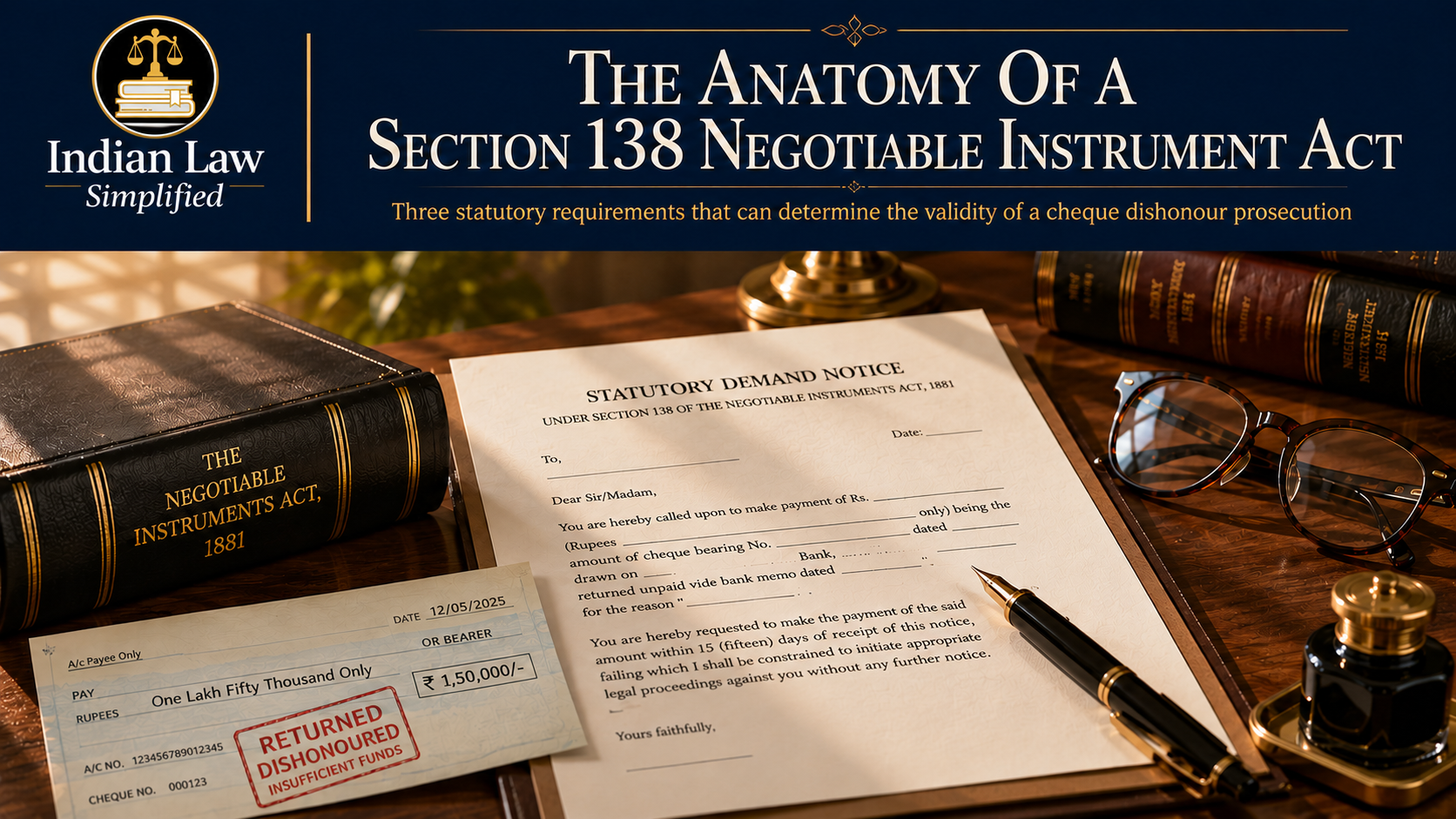
Understanding the legal requirements of a valid statutory notice under the Negotiable Instruments Act, 1881
Introduction
A cheque dishonour by itself does not constitute an offence under Section 138 of the Negotiable Instruments Act, 1881. The law contemplates a sequence of statutory requirements that must be satisfied before criminal liability can arise. Among these, the statutory demand notice occupies a position of particular significance.
The notice serves a dual purpose. It provides the drawer of the cheque with a final opportunity to honour the payment and, at the same time, constitutes the statutory foundation for initiating prosecution under Section 138. Consequently, the validity of the prosecution often depends upon the validity of the notice itself.
Although the statutory requirements appear straightforward, disputes frequently arise over the contents of the notice, the manner in which it is served, and the timelines prescribed by the Act. A carefully drafted notice not only fulfils the legislative mandate but also minimises the scope for avoidable technical objections during the proceedings.
This article examines three important aspects of a statutory notice under Section 138 that frequently arise in practice and discusses the legal principles governing each of them.
The Statutory Framework
Section 138 creates a statutory offence only when the conditions stipulated therein are fulfilled. Broadly stated, the following sequence is contemplated:
- the cheque must be presented within its period of validity;
- upon dishonour, the payee or holder in due course must issue a written demand notice within thirty days of receiving information regarding dishonour from the bank;
- the drawer must be afforded fifteen days from the date of receipt of the notice to make payment; and
- only upon failure to make payment within the stipulated period does the cause of action arise for filing a complaint under Section 138.
Each of these statutory requirements is an integral part of the prosecution. Compliance with one cannot compensate for non-compliance with another.
1. A Demand Notice Must Clearly Demand the Cheque Amount
One issue that has repeatedly come before the courts is whether a statutory notice becomes invalid if it demands amounts in addition to the cheque amount, such as interest, legal expenses or other incidental charges.
Section 138 requires the payee to make a demand for payment of “the said amount of money”, namely, the amount covered by the dishonoured cheque. The statutory requirement is therefore directed towards the cheque amount itself.
This question was considered by the Supreme Court in Suman Sethi v. Ajay K. Churiwal & Anr., (2000) 2 SCC 380, where the Court held that a notice does not become invalid merely because it also includes claims for interest, costs or other incidental amounts. However, the demand for payment of the cheque amount must remain clear, distinct and ascertainable. Where the notice creates uncertainty as to what payment is required to avoid prosecution, the validity of the notice may be open to challenge.
The principle emerging from the decision is a practical one. While additional claims may be made, the statutory demand should always leave no ambiguity regarding the amount represented by the dishonoured cheque.
In Kaveri Plastics v. Mahdoom Bawa Bahrudeen Noorul, 2025 INSC 1133, the Supreme Court built upon the Suman Sethi principle. The Court ruled that if a payee demands an amount different from the exact cheque amount (even under the defense of a “typographical error”), and the extra elements are not clearly broken up or severable, the entire notice is structurally defective, rendering the criminal complaint completely unmaintainable.
2. Careful Compliance with the Statutory Timelines Is Essential
The statutory timelines prescribed under Section 138 are not merely procedural. They constitute an integral part of the legislative scheme and determine when the right to prosecute arises. An otherwise valid claim may fail if the statutory notice is not issued within the prescribed period or if the complaint is instituted before the cause of action has accrued.
Section 138 requires the payee or holder in due course to issue a written demand notice within thirty days of receiving information from the bank regarding the dishonour of the cheque. Once the notice is received, the drawer is entitled to fifteen days to make payment. It is only upon the expiry of this period, without payment being made, that the cause of action arises for filing a complaint under Section 142 of the Act.
The computation of these statutory periods has been the subject of judicial consideration. In Econ Antri Ltd. v. Rom Industries Ltd., (2014) 11 SCC 769, the Supreme Court clarified that the principles contained in the General Clauses Act, 1897, particularly Section 9 thereof, apply while computing the period prescribed under the Negotiable Instruments Act. The Court observed that, unless a contrary intention appears, the day from which the period is to be reckoned is ordinarily excluded while computing limitation.
The decision reinforces an important principle – statutory timelines should be calculated with precision. An error in computation may result in a notice being issued beyond the prescribed period or a complaint being filed before the cause of action has legally arisen.
A careful reading of Sections 138 and 142 indicates that each statutory step is dependent upon the completion of the previous one. Compliance with the timelines, therefore, is not a matter of procedural convenience but a statutory necessity.
3. Proper Service of the Statutory Notice Is Equally Important
The statutory scheme under Section 138 does not end with the issuance of the demand notice within the prescribed period. The notice must also be served in accordance with law so that the drawer is afforded the opportunity contemplated by the statute to make payment within the stipulated time.
Questions relating to refusal, avoidance of service, change of address or deliberate non-acceptance frequently arise in proceedings under Section 138. The law has, therefore, evolved principles to ensure that a drawer cannot defeat an otherwise valid prosecution merely by avoiding service of the statutory notice.
The legal position was authoritatively settled by the Supreme Court in C.C. Alavi Haji v. Palapetty Muhammed & Anr., (2007) 6 SCC 555. The Court held that where a notice is properly addressed, prepaid and dispatched by registered post, the presumption of due service under Section 27 of the General Clauses Act, 1897 and Section 114 of the Indian Evidence Act would ordinarily apply.
The Court further observed that a drawer who deliberately avoids service cannot subsequently rely upon such avoidance to defeat the prosecution. Significantly, the Court also held that even where the drawer contends that the statutory notice was not received, the receipt of summons along with a copy of the complaint affords another opportunity to make payment within fifteen days. If payment is still not made, the drawer cannot ordinarily take advantage of the plea of non-service.
The decision reflects an important aspect of the statutory scheme. While the law requires strict compliance with the procedural requirements prescribed under Section 138, it does not permit those requirements to be used as a means of frustrating the very object of the legislation.
Accordingly, while statutory presumptions may operate in appropriate cases, it is always advisable to ensure that the notice is correctly addressed and dispatched through a recognised mode capable of establishing proof of dispatch and, wherever possible, proof of delivery.
Conclusion
As the foregoing discussion demonstrates, a statutory notice under Section 138 is far more than a procedural formality. It constitutes the statutory foundation of a cheque dishonour prosecution and, therefore, requires careful compliance with the statutory requirements governing its contents, timelines and service. Attention to these aspects not only minimises avoidable technical objections but also enables the court to adjudicate the dispute on its substantive merits.
Leave a Reply